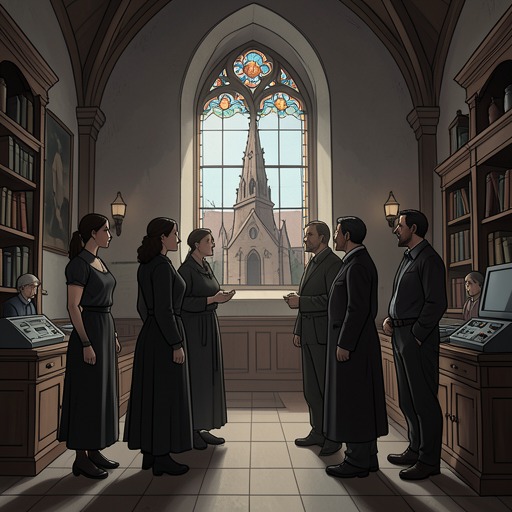
Congregation for the Doctrine of the Faith
La piel del tamborThe Congregation for the Doctrine of the Faith is the Roman institution whose reach turns Lorenzo Quart’s inquiry in Seville into more than a local church dispute. In the novel it is identified with the old Holy Office and the Inquisition, and its director, Cardinal Jerzy Iwaszkiewicz, embodies the threat of a revived inquisitorial severity. Although the Pope initially assigns the investigation to the Institute for External Works, the Congregation remains the force waiting behind that decision: if the inquiry finds sufficiently serious grounds, the matter may be transferred to its official arm.
Identity and authority
The Congregation is introduced by its historical institutional names and its current office. Jerzy Iwaszkiewicz is described as the former bishop of Kraków, raised to the cardinalate by Pope Wojtyła, and prefect of the Sacred Congregation for the Doctrine of the Faith, which had been known before 1965 as the Holy Office or the Inquisition. Even in silhouette, his identity and what he represents are unmistakable. When Lorenzo Quart greets him, Iwaszkiewicz does not answer; his silence establishes an authority that does not need to meet a visitor on equal terms.
The institution's authority in the Seville affair is not initially direct jurisdiction over the parish. Paolo Spada explains that Cardinal Iwaszkiewicz wants the Holy Office to take up the case, in the old style, while the Pope prefers a proper investigation and considers involving the Congregation excessive. The phrase “old style” carries the danger of a coercive intervention, and Iwaszkiewicz’s repeated insistence that they no longer burn anyone sounds less reassuring than ominous. Spada likens the proposed escalation to using artillery or a flamethrower against flies; the menace lies in the disproportion between a local inquiry and the institutional force that could be brought to bear on it.
Rivalry within the Curia
The Congregation’s role is shaped by its competition with the Institute for External Works. Spada tells Quart that the two bodies once cooperated in what he calls fraternal concord, but that the balance has changed: the Holy Office is growing at the Institute’s expense. A scandal that dismantled the Vatican’s financial apparatus and the Polish team’s turn toward orthodoxy have helped transform cordial relations into a ruthless internal reckoning. The Seville assignment is therefore both an investigation and a contest over which Roman institution will control the response.
Spada says the Institute has been chosen for the moment, with the qualification emphasized: if evidence of gravity emerges, the problem can be transferred to the Congregation’s official arm. Iwaszkiewicz counters that the Inquisition ceased to exist thirty years earlier. Spada corrects himself, replacing the obsolete name with the Congregation for the Doctrine of the Faith, but the correction does not erase the implication of continuity. When the cardinal repeats that no one is burned anymore, his words carry a darker echo of threat rather than a simple denial of violence.
Spada is candid with Quart about the political purpose of the assignment. The computer hacker’s intrusion and the church affair might ordinarily have fallen within the competence of the Archbishop of Seville and his dealings with parish priests. But any issue that attracts the Pope’s attention becomes another opening in the Curia’s internal struggle. Spada has chosen his best man because he needs information and a substantial report showing that the Institute is acting. Such a report may satisfy the Pope while keeping Iwaszkiewicz at bay. The Congregation’s power is thus felt even before it formally takes over: its anticipated intervention determines how another Vatican office handles the case.
Doctrine, discipline, and dissent
Spada presents the Congregation as an instrument for enforcing unity through authority. He argues that the Church’s structure remains shaped by medieval absolutism beneath the spectacle of papal travel and public devotion. In his account, the Congregation’s importance has grown since the 1980s, as a means of closing the mouths of dissenters and keeping the Church compact and unquestioned. He names intellectual disqualification, excommunication, and the stake as the traditional weapons of institutional discipline, invoking the Inquisition not merely as a vanished tribunal but as a model of coercive power.
That analysis is sharpened by Quart’s memory of Nelson Corona, a Brazilian priest associated with the Church of Liberation whose coffin Quart had supplied. The memory connects the Congregation’s hard-line reputation to the suppression of progressive clergy. Spada refers to the silencing of theologians such as Küng, Castillo, Schillebeeck, and Boff, and describes the Church’s historical resolution of internal struggle as silencing dissidents or casting them overboard. His criticism is political and personal: the Congregation’s growth threatens not only rival offices but also the space available to disagreement within the Church.
The Seville dispute and institutional procedure
The Congregation’s possible intervention matters because Nuestra Señora de las Lágrimas is caught between ecclesiastical discipline, an old privilege, and a redevelopment deal. Archbishop Aquilino Corvo tells Quart that a papally sanctioned privilege dating to 1687 requires a Thursday Mass for the soul of Gaspar Bruner de Lebrija if the church is to retain its rights. Father Ferro goes further than the condition requires: he celebrates Mass every day at eight in the morning, except on Sundays and feast days, when he celebrates twice. The practice is both a devotional routine and a practical obstacle to secularizing the building before demolition.
Corvo says he has sought Ferro’s suspension from office, but the request to Rome is moving slowly. He suggests that officials are waiting for Quart to return with his report after the Vatican computer system was infiltrated. The delay leaves the church’s future unsettled while Banco Cartujano has a redevelopment operation ready. The bank offers compensation to the diocese, promises to finance a church in one of Seville’s poorer districts, and proposes a foundation supporting social work among the Roma community. These benefits make the transaction easier to defend, but they do not resolve the legal and pastoral conflict over Ferro’s Masses and the old privilege.
Macarena Bruner explains the practical pressure created by that condition: on Thursdays, an emissary of the archbishop and a notary paid by Pencho Gavira watch the last row for an irregularity or lapse. The church’s protection depends on repeated observance, while the institution seeking to remove the obstacle can monitor whether that observance fails. The resulting contest is not simply between belief and commerce. It turns on who can interpret and enforce rules, how long Roman procedures take, and whether the parish priest’s conduct can be made grounds for removing him.
Ritual and the Congregation’s significance
The novel sets the Congregation’s language of discipline against the lived effect of Father Ferro’s liturgy. At a morning Mass attended by about twenty parishioners, Ferro wears an amice, an older vestment associated with the pre-Vatican II rite, and an archaic guitar-shaped chasuble. He celebrates portions of the service in Latin, despite the post-Paul VI rules requiring Mass in the local language to encourage understanding and participation. The Latin is not presented as a major violation, and churches with special privileges may use it; nevertheless, it reveals Ferro’s partial resistance to ecclesiastical modernization.
Quart, who initially views Ferro with disdain, is moved by the priest’s ritual authority. The old gestures and words create a quiet refuge for tired parishioners, whether or not they understand every phrase. What matters in the moment is the comfort offered by shared attention, familiar words, and the priest’s hands at the altar. This scene complicates the Congregation’s claim to defend faith through discipline: the institutional dispute is about authority and conformity, but the parish’s attachment to its church is also sustained by a ritual that provides consolation.
The Congregation therefore operates both as a formal destination for a possible disciplinary case and as a looming symbol of the Church’s capacity to silence dissent. Its intervention could affect Father Ferro, the Thursday Mass condition, and the proposed demolition, while its rivalry with the Institute shapes the very investigation meant to clarify the affair. The contrast between the cardinal’s silent, threatening presence and the repeated local liturgy makes the larger conflict visible: power can decide which office acts, but the parish’s fragile protection rests on a practice renewed at the altar, week after week.